

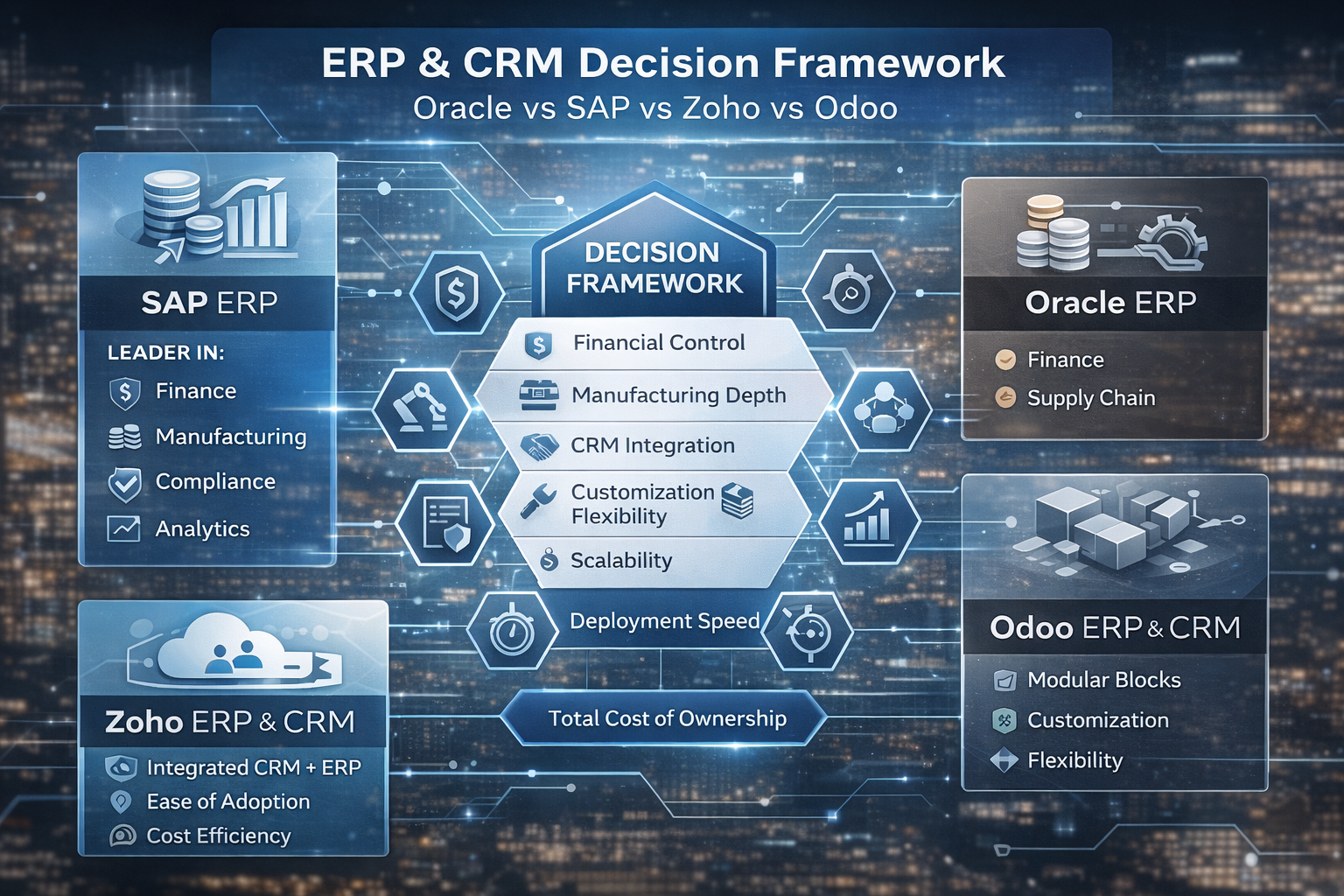
ERP and CRM Platform Decision Framework: Oracle, SAP, Zoho and Odoo
Choosing an ERP or CRM platform is one of the most important technology decisions a growing company will make. The wrong choice can create years of workarounds. The right choice can improve sales visibility, financial control, inventory accuracy, service quality and management reporting. This guide gives business leaders a practical way to compare Zoho, Odoo, SAP and Oracle without getting lost in product brochures.
Start with business complexity, not software popularity
Every major platform has strengths. Zoho is attractive for businesses that want connected CRM, finance, HR, projects, support and automation without a heavy enterprise rollout. Odoo can be a strong fit when operations need integrated workflows across inventory, accounting, sales, purchasing, POS or e-commerce. SAP and Oracle are often considered by larger or more complex organizations with deeper governance, reporting and enterprise process requirements.
The decision should not start with the question “Which software has more features?” A better question is: which platform can support the way the business must operate over the next three to five years? The answer depends on process maturity, reporting needs, integration requirements, budget discipline and how much change users can absorb.
Platform fit by business scenario
| Scenario | Strong fit to consider | Reason |
|---|---|---|
| Sales-led SME | Zoho CRM, Zoho One | Good fit when the priority is pipeline control, customer follow-up, quote flow, invoicing and automation across teams. |
| Finance and operations control | Zoho ERP, Odoo ERP | Useful when the business needs tighter links between sales, purchases, inventory, billing and reporting. |
| Trading or distribution | Odoo, SAP Business One, selected Zoho workflows | Inventory depth, warehouse rules, price lists and accounting controls should be checked carefully before selection. |
| Enterprise governance | SAP or Oracle | Better aligned when the organization has complex controls, larger IT teams, formal governance and multi-year transformation programs. |
Questions that prevent a wrong selection
How complex are sales, approvals, procurement, inventory, finance, HR and service workflows? The platform must match real process depth, not only demo screens.
Which reports will management use weekly? Decide whether the platform can produce those numbers without manual spreadsheet correction.
List systems that must connect: website, POS, payment gateway, warehouse, payroll, banking, BI or customer support channels.
Even a good platform can fail if the business cannot provide process owners, test data, user time and decision-making support.
For businesses leaning toward Zoho, the next step is usually a focused discovery around CRM, finance, support, HR and automation. ANSI Technologies supports this through Zoho Solution Services, including implementation planning, configuration, workflow automation and post go-live support.
How to compare total cost without underestimating risk
License cost is only one part of the decision. A platform that looks cheaper during purchase can become expensive if integrations are poorly planned, customizations are uncontrolled, reports need manual work or users resist the new workflow. A platform that looks expensive can be justified when it reduces operational risk and supports long-term scale.
- Include discovery, configuration, migration, testing and training effort.
- Estimate future support, change requests and report improvement cycles.
- Check whether the platform will reduce manual reconciliation and duplicate data entry.
- Evaluate whether integrations will need custom API work or standard connectors.
- Review whether users can realistically adopt the system in the planned timeline.
- Keep a budget for post go-live optimization, not only initial implementation.
Where each platform usually needs expert guidance
Zoho projects need strong app mapping. A business may need Zoho CRM consulting for sales, Zoho Books setup for finance and Zoho One implementation for a broader connected operating model. Odoo projects need process governance across modules, especially when inventory, accounting, POS, manufacturing or e-commerce are involved. For that path, an Odoo rollout and consulting support can help control scope and adoption.
SAP projects, upgrades or support models require clear governance, documentation and experienced support ownership. ANSI Technologies supports these requirements through SAP consulting. When the selection decision itself is unclear, CTO on demand services can help leadership compare options from a technology, risk and business value point of view.
How to run a fair platform evaluation workshop
A good platform decision workshop should include business owners, finance, sales, operations, customer support and technology stakeholders. The goal is not to let every department request every possible feature. The goal is to identify the workflows that create the highest risk or the highest value, then test whether each platform can support them without unnecessary complexity.
Use real examples: one difficult customer quote, one delayed invoice, one stock exception, one approval conflict, one support escalation and one management report that is currently prepared manually. These examples reveal more than a standard product demo because they show where process ownership, data quality and integration rules will matter after go-live.
Rate how well the platform supports the workflow with standard configuration, controlled customization or integration.
Estimate how much user change is required and whether managers can enforce the new process.
Confirm whether the desired dashboards can be produced from clean system data rather than manual exports.
The final recommendation should clearly explain why a platform is preferred, what should be implemented first, what should be deferred and what risks need executive approval. This gives leadership a decision document, not just a vendor comparison table.
How to document the final decision
The final selection note should be short enough for leadership to read and specific enough for implementation teams to act on. Include the preferred platform, the first-phase scope, integration assumptions, reporting expectations, data migration risks, training needs and support model. This avoids a common problem where a platform is approved but the delivery team later discovers that every department expected something different.
A well-documented decision also gives implementation partners a stronger starting point. It reduces scope confusion, protects budget and creates a clear baseline for future change requests.
Implementation readiness before signing
Before signing with any vendor, confirm that internal owners are available for workshops, data extraction is possible, old reports are understood and users can participate in testing. A platform selection without implementation readiness can still fail even when the selected software is appropriate.
Frequently asked questions
How should a business choose between Zoho, Odoo, SAP and Oracle?
The decision should be based on process complexity, budget, customization needs, reporting requirements, integration depth, user readiness and the level of governance the business can sustain.
Is Zoho suitable for growing businesses?
Zoho can be suitable when the business needs connected CRM, finance, projects, support, HR and automation with practical implementation scope and controlled workflows.
When should a business consider Odoo or SAP instead of Zoho?
Odoo may fit when operational workflows need deeper ERP configuration across inventory, accounting and sales. SAP may fit when the organization has more complex enterprise governance and support requirements.
Can ANSI Technologies help with platform selection?
Yes. ANSI Technologies supports platform assessment, process mapping, vendor evaluation, Zoho implementation, Odoo implementation and SAP consulting.
Need help choosing the right ERP or CRM platform?
ANSI Technologies can review your workflows, reporting needs, integrations and growth plans before you commit to a platform.
Request Zoho Solution Services