

Odoo Implementation Services That Turn ERP Plans Into Working Operations
This page is for businesses that already understand Odoo’s potential and now need a serious execution plan. ANSI Technologies helps you move from ERP discussion to a working Odoo system through discovery, blueprinting, configuration, migration, integrations, UAT, training, go-live, hypercare and managed support.
From blueprint to a dependable go-live
Our teams focus on business-process design, data quality, practical integration, role-based adoption and support so that the ERP is useful in everyday operations—not just during a demonstration.

A successful Odoo project needs more than module activation
Odoo can connect finance, sales, purchase, inventory, manufacturing, retail, eCommerce and reporting. But the value comes only when the implementation is planned correctly, configured around real processes, tested with business scenarios and supported after go-live.
ANSI Technologies helps you move from ERP discussion to a controlled rollout with clear scope, accountable workstreams, clean data migration, practical integrations, user training and a stable go-live plan.
What this approach gives you
A practical implementation approach reduces rework, prevents unclear ownership, improves data quality, protects go-live stability and helps users adopt Odoo with confidence. You get a project that is designed for operations, not just a software installation.
Odoo does not fail because of modules. Projects fail because execution is weak.
The difference between a demo and a successful ERP is disciplined implementation. ANSI Technologies focuses on scope clarity, data readiness, controls, integrations, user adoption and post go-live stability.
Weak implementation creates
- Modules enabled without a clear process blueprint
- Too much customization before understanding standard Odoo capability
- Messy product, customer, vendor and opening-balance data
- Unclear user roles, approvals and control ownership
- Disconnected integrations and manual reconciliation outside the system
- Users trained too late, resulting in low adoption after go-live
ANSI’s implementation approach creates
- Business blueprint before build
- Configuration-first approach with careful customization only where needed
- Migration templates, trial uploads and validation checkpoints
- Role-based access, approval flows and reporting ownership
- Documented integration flows with testing and fallback planning
- Training, UAT, cutover and hypercare as part of the delivery plan
A complete Odoo implementation roadmap from first workshop to stable operations
A strong ERP rollout is not a single activity. It is a controlled sequence of decisions, configuration, validation and adoption. We structure the implementation so your team knows exactly what is being delivered, tested and signed off.
Discovery and current-state review
We review how your teams currently handle sales, purchases, finance, inventory, production, POS, eCommerce, projects or services. The goal is to understand real working processes, not just software requirements.
Scope and phasing
We split the implementation into practical phases so core operations can go live safely while advanced features, integrations and enhancements are planned without blocking the first value release.
Solution blueprint
The blueprint defines modules, process flows, approvals, master data, reporting, integrations, migration scope, user roles, UAT scenarios and go-live responsibilities.
Environment and master setup
We set up company structure, users, warehouses, journals, taxes, units of measure, product categories, price lists, analytic dimensions and security foundations.
Module configuration
Odoo modules are configured around signed-off workflows: finance, sales, purchase, CRM, inventory, MRP, POS, eCommerce, HR, projects, helpdesk and reporting based on scope.
Controlled customization
Where standard configuration is not enough, we design upgrade-conscious customizations such as fields, reports, approvals, automation, dashboards, portal changes or custom modules.
Data migration preparation
Data is mapped, cleaned, structured and loaded through controlled templates. We validate customers, vendors, items, opening balances, stock, employees and transactions as per scope.
Integrations and automation
We connect Odoo with payment gateways, eCommerce platforms, shipping systems, BI dashboards, legacy systems, marketplaces, SMS/email tools and custom applications where needed.
Reports and dashboards
Leadership and department teams need visibility. We configure operational reports, management dashboards, ageing, margin, stock, sales, purchasing and workflow reports.
UAT and scenario testing
Users test real business scenarios: lead-to-cash, procure-to-pay, stock movement, manufacturing order, POS billing, eCommerce order, returns, approvals and month-end reports.
Training and cutover
We train users by role, prepare go-live checklists, freeze legacy data, load final balances, validate key records and support users during the first business cycles.
Go-live, hypercare and support
After go-live, we stabilize the system, resolve early issues, track enhancements, monitor adoption and move into a structured support and continuous improvement model.
Odoo implementation workstreams we plan, configure and stabilize
Each department needs a different implementation plan. We define the process, configure the module, migrate the right data, test real scenarios, train users and prepare the business for daily execution on Odoo.
Finance & accounting setup
Chart of accounts, journals, taxes, customer invoices, vendor bills, expenses, payments, approvals, ageing, reconciliation and management reporting.
CRM and sales process
Lead stages, opportunity tracking, quotations, pricelists, sales orders, approvals, customer communication and pipeline visibility.
Purchase and vendor flows
RFQ, purchase orders, approvals, vendor bills, goods receipt, landed cost support, vendor pricing and procurement visibility.
Inventory and warehouse
Multi-warehouse setup, locations, stock moves, barcode flows, replenishment, internal transfers, lot/serial traceability and stock valuation support.
Manufacturing execution
BOMs, routings, work centers, manufacturing orders, quality checks, WIP visibility, production planning and cost-control support.
Retail POS rollout
Store setup, products, cashier flows, discounts, returns, payments, sessions, inventory sync and branch-level reporting.
eCommerce operations
Online catalog, checkout process, website flows, payment integration, shipping coordination, inventory sync, order handling and returns.
HR, projects and services
Employee records, attendance/leave scope, projects, timesheets, helpdesk, service delivery tracking and customer support workflows.
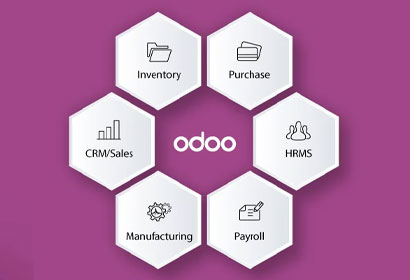
The blueprint is the most important document in the Odoo implementation
A good Odoo implementation starts before configuration. The blueprint prevents scope confusion, missing approvals, weak reports, bad data migration and misunderstood user expectations. It becomes the reference document for build, UAT and go-live.
Process design
AS-IS review, TO-BE flow, process owners, exceptions and operating rules.
Module and feature scope
What is included now, what is deferred, and what requires customization or integration.
Controls and approvals
User roles, maker-checker flows, approval limits, document status and audit readiness.
Reports and KPIs
Dashboards, operational reports, finance controls, ageing, margins, inventory and leadership views.
Odoo migration is not only importing Excel files. It is a business validation exercise.
Businesses often underestimate migration. Clean masters and accurate opening balances decide whether users trust the new ERP from day one. ANSI follows a staged migration process with templates, trial uploads, validation and cutover checks.
Source data review
We review current data from Excel, Tally, legacy ERP, accounting systems, inventory tools, websites, POS systems or custom databases.
Mapping and templates
We map fields into Odoo structures for customers, vendors, products, BOMs, employees, opening balances, stock and transaction history as per scope.
Cleansing support
Duplicate masters, missing tax details, inconsistent UOMs, wrong product categories and inactive records are identified before import.
Trial migration
Trial imports help validate record counts, relationships, opening values, stock quantities, serial/lot data and finance balances before final cutover.
Reconciliation
Stock, receivables, payables, bank, tax and opening balances must be checked with business owners before go-live approval.
Final cutover
Cutover includes data freeze, final extraction, final import, validation, access readiness, go-live checklist and support coverage.
Odoo becomes more powerful when it connects cleanly with the rest of your business
Many businesses need Odoo to connect with eCommerce platforms, payment gateways, shipping partners, marketplaces, websites, BI tools, HR systems, document signing, legacy databases or custom applications. We document integration ownership, data flow, frequency, failure handling and test cases.
Commerce and payments
Website, online store, payment gateway, POS, marketplace and order synchronization.
Logistics and dispatch
Shipping, last-mile, delivery tracking, labels, packing, fulfillment status and warehouse flows.
Reporting and analytics
BI dashboards, reporting databases, Excel exports, data pipelines and leadership scorecards.
Communication and workflow
Email, SMS, WhatsApp notifications, approvals, reminders, helpdesk and customer updates.
| Integration area | What we define before build | Why it matters |
|---|---|---|
| Master data sync | Source system, sync direction, duplicate handling, mandatory fields and ownership. | Prevents conflicting customer, product, pricing and vendor records. |
| Transaction sync | Order, invoice, payment, shipment, receipt, return and status mapping. | Keeps teams aligned and reduces manual reconciliation. |
| Error handling | Logs, alerts, retry rules, responsible team and fallback process. | Ensures integration failures do not silently damage operations. |
| Security and access | API keys, roles, access levels, audit logs and environment separation. | Protects business data and supports future governance. |
Roles, approvals and controls are not optional in a serious ERP rollout
A business system should not give everyone the same access. We help define practical controls so Odoo supports accountability without slowing down day-to-day work.
Role-based access
User groups, department-level permissions, menu access, approval responsibilities and admin controls.
Approval matrix
Purchase approvals, sales discounts, credit limits, expenses, finance controls and operational sign-offs.
Master governance
Product, customer, vendor, UOM, categories, price lists, tax data and naming standards.
Audit readiness
Change tracking, document status, user ownership, finance visibility and process accountability.
A successful go-live is planned weeks before the launch date
Go-live should not be a surprise event. We prepare users through scenario testing, issue resolution, training, data validation, cutover planning and hypercare coverage.
Scenario-based UAT
We test real workflows: lead to sale, purchase to receipt, stock transfer, manufacturing order, POS billing, eCommerce order, payment, return, report and approval.
Role-based training
Training is designed by user role: sales, accounts, warehouse, purchase, production, store users, management, admin and support users.
Cutover planning
Cutover defines legacy freeze, final migration, validation, user access, go-live checklist, business owner sign-off and support escalation process.
Go-live command center
During initial live operations, issues are tracked, prioritized and resolved with business owners so users do not lose confidence.
Hypercare stabilization
We support the first transaction cycles, reports, closing activities and operational issues to stabilize adoption.
Enhancement backlog
Not every request should delay go-live. We separate critical fixes from improvements and manage a backlog for future phases.
Implementation options for different stages of business maturity
Every company does not need the same implementation model. We recommend phasing based on business urgency, users, modules, data readiness, integrations and risk tolerance.
QuickStart rollout
For focused teams that need core finance, sales, purchase and inventory with limited customization and clean scope.
- Best for simple operations
- Configuration-first approach
- Limited migration and reports
- Fast adoption and handover
Growth ERP rollout
For growing businesses that need multiple departments, approvals, inventory controls, dashboards and selected integrations.
- Multi-module scope
- Defined approvals and user roles
- Migration and UAT cycles
- Hypercare and support planning
Enterprise phased program
For multi-location, multi-company, manufacturing, retail, distribution or heavily integrated businesses.
- Detailed blueprint and governance
- Multiple workstreams
- Complex migration and integrations
- Continuous improvement roadmap
What you receive from ANSI Technologies during an Odoo implementation
Business blueprint
Process flows, module scope, roles, approvals, data scope, integration view and implementation roadmap.
Configured Odoo system
Modules configured for the agreed scope with users, workflows, forms, reports and tested scenarios.
Migration and validation pack
Templates, mapping, data import support, opening balances, stock validation and reconciliation checklist.
Training and support model
User training, admin handover, hypercare plan, support process and enhancement backlog.
Get a practical Odoo implementation roadmap
Share your business type, current systems, users, locations, modules and timeline. We will recommend the right Odoo rollout path, implementation phase plan, data migration approach, integration scope and post go-live support model.
- Module selection and phasing
- Implementation effort estimate
- Data migration and integration view
- Support model recommendation
The real value of Odoo comes after users start running the business on it
Post go-live support is not just bug fixing. It is the stage where users build confidence, reports become reliable, management starts using dashboards, and the next phase of automation can be planned.
Hypercare
Support during the first live cycles, issue triage, user guidance and configuration corrections.
Managed support
L1/L2/L3 support model, ticket handling, SLA expectations and recurring review meetings.
Continuous improvement
Enhancement backlog, phase-2 roadmap, automation opportunities and dashboard improvements.
Admin enablement
Internal admin training, documentation, access control guidance and handover discipline.
Odoo implementation expertise across 8 high-demand business models
Every Odoo implementation must be shaped around the way the business buys, sells, stocks, produces, delivers, invoices and reports. ANSI Technologies configures Odoo for practical execution across manufacturing, trading, distribution, retail, eCommerce and service-driven operating models.
Manufacturing ERP
BOMs, routings, work centers, manufacturing orders, quality checks, maintenance, production planning, WIP visibility and product costing.
Trading & Distribution ERP
Procurement, sales orders, inventory, multi-warehouse dispatch, pricing, credit control, landed cost, replenishment and receivables visibility.
Retail ERP
POS billing, cashier controls, store inventory, promotions, discounts, returns, loyalty, branch-level reporting and finance reconciliation.
eCommerce ERP
Online catalog, order management, stock sync, marketplace flows, payment reconciliation, delivery updates, returns and customer communication.
Automotive & Spare Parts
SKU-heavy inventory, vehicle compatibility, supplier sourcing, counter sales, warehouse picking, substitutions, margins and slow-moving stock visibility.
FMCG & Consumer Goods
Batch tracking, expiry control, distributor orders, pricing rules, promotions, returns, warehouse movement, van sales and demand visibility.
Contracting, Projects & Services
Project costing, timesheets, milestones, purchase allocation, expense tracking, billing, approvals, service delivery and profitability reporting.
Healthcare, Pharma & Medical Supplies
Batch and expiry tracking, regulated inventory, supplier management, purchase controls, sales operations, returns and traceability-focused reporting.
Before starting Odoo implementation, answer these questions
These questions help identify scope, risk and priority. They also help us prepare a more realistic implementation proposal.
Business and process readiness
- Which departments must go live first?
- Which processes are currently manual, delayed or error-prone?
- Who owns finance, sales, purchase, inventory, warehouse, production and reporting decisions?
- Which approvals and controls are mandatory from day one?
- Which reports are required for management and compliance?
Data and technology readiness
- Where is current data stored: Excel, Tally, legacy ERP, POS, website or custom apps?
- How clean are customers, vendors, products, stock and opening balances?
- Which systems must integrate with Odoo?
- Who will validate migrated data before go-live?
- What is the cutover date and who will support users during the first live cycle?
Frequently Asked Questions on Odoo Implementation Services
These FAQs are written for buyers who want to understand the implementation journey before committing to an ERP rollout.
How is an Odoo implementation project usually structured?
+What does ANSI need to prepare an Odoo implementation proposal?
+Can Odoo be implemented in phases?
+How do you avoid unnecessary customization?
+What are the biggest risks in Odoo implementation?
+Do you support businesses outside UAE?
+Do you handle Odoo migration from Tally or Excel?
+Can you take over a failed or incomplete Odoo implementation?
+Our Partners









Ready to Plan Your Odoo Implementation?
Share your current systems, users, modules, locations and timeline. We will help you decide the right Odoo rollout path, project phases, migration plan, integration scope and support model.