

There is nothing wrong with starting a business using spreadsheets.
In fact, spreadsheets are often the fastest and simplest way to manage information when a company is small.
Customer lists can be maintained in Excel.
Inventory can be tracked in a workbook.
Invoices can be recorded manually.
Sales forecasts can be prepared in another sheet.
For a small team, this may work perfectly well.
The problem begins when the business grows faster than its processes.
More customers arrive. More products are added. More employees become involved. Multiple locations appear. Orders increase. Finance needs better reporting. Management wants real-time visibility.
Suddenly, the spreadsheet that once saved time becomes another source of work.
This is often the point when businesses begin evaluating an ERP system such as Odoo.
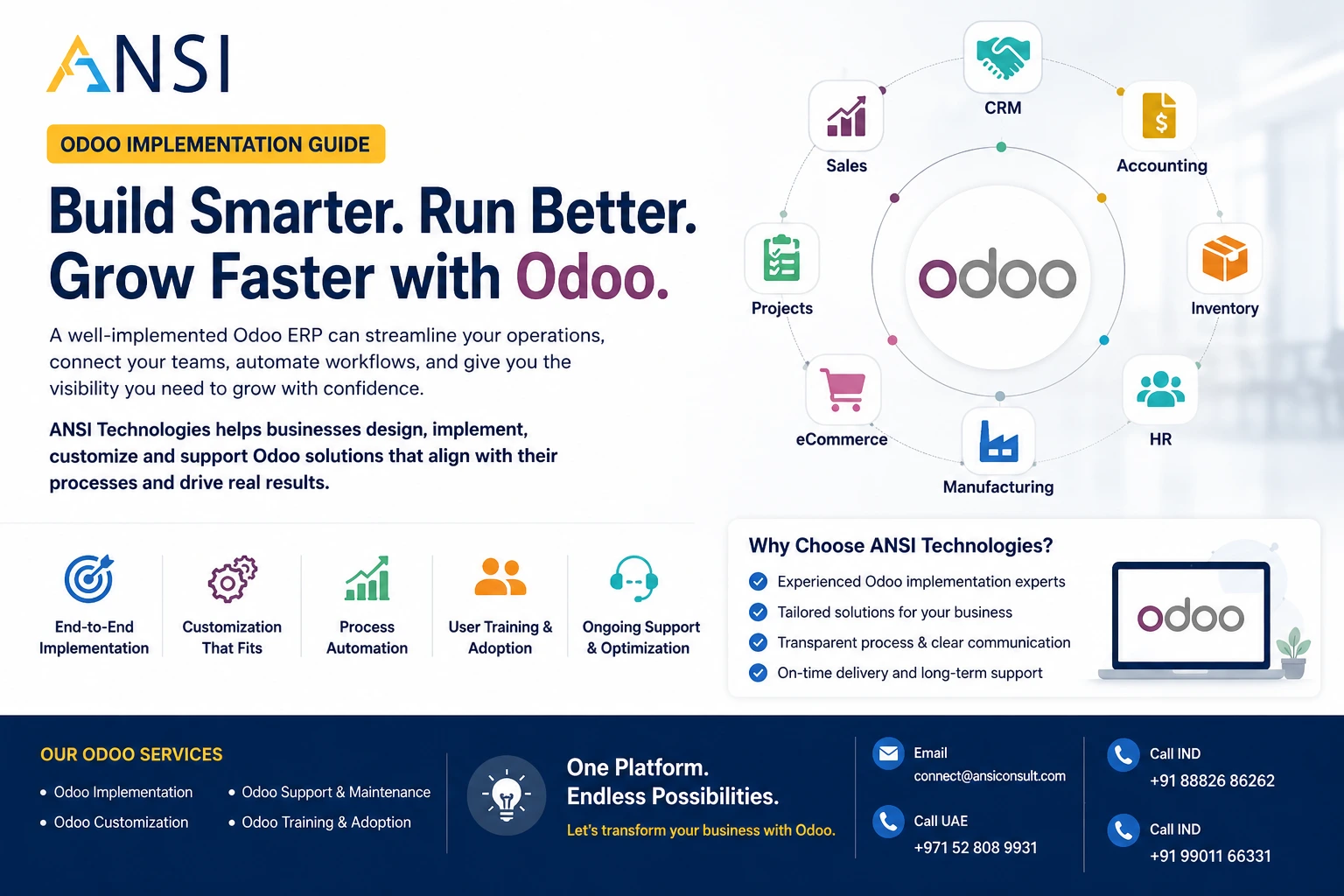
Odoo provides an integrated suite of business applications covering areas such as CRM, accounting, inventory, manufacturing, eCommerce, projects, and other business functions.
But how do you know when your business is actually ready?
Here are seven common signs.
1. Your Team Is Maintaining Multiple Versions of the Same Data
One of the earliest warning signs is duplicate information.
Sales has a customer spreadsheet.
Finance has a customer list.
Operations has another file.
The warehouse maintains its own product information.
Management receives a manually prepared report.
The problem isn't simply having several files.
The real problem is that nobody is completely sure which version is correct.
A customer changes their billing information.
One department updates it.
Another department continues using the old information.
A product price changes.
Someone forgets to update another spreadsheet.
Over time, small inconsistencies become operational problems.
An ERP environment can provide a more centralized approach to business information.
Instead of asking:
“Which spreadsheet has the latest information?”
employees can work from a structured system with defined records, permissions and workflows.
2. Inventory Is Becoming Difficult to Control
Inventory management can become complicated surprisingly quickly.
Businesses may start with a simple stock sheet.
Then they add:
- Multiple products
- Different product variants
- Multiple warehouses
- Purchase orders
- Sales orders
- Returns
- Transfers
- Reordering
- Stock adjustments
- Barcode processes
- Supplier management
At this stage, manually maintaining inventory information becomes increasingly difficult.
Odoo provides inventory functionality designed around stock movements, warehouses and related operational processes, while its manufacturing capabilities support production planning and work orders.
For a growing organization, this can provide a foundation for better inventory visibility.
ANSI Technologies helps businesses evaluate and implement Odoo around real operational requirements rather than simply activating modules.
3. Finance and Operations Are Working Separately
Another common warning sign appears when finance doesn't have easy access to operational information.
For example:
Sales receives an order.
Operations processes it.
Inventory updates stock.
Finance later needs to determine what happened.
If each department maintains separate records, reconciliation becomes a regular task.
Employees may spend hours comparing:
- Sales orders
- Purchase records
- Inventory
- Invoices
- Payments
- Customer accounts
A connected ERP approach can reduce this fragmentation.
ANSI Technologies provides Odoo ERP implementation services covering areas such as configuration, migration, integrations, testing, training, and go-live support.
4. Employees Are Repeating the Same Work
Ask your team a simple question:
“What do you have to enter more than once?”
You may be surprised by the answer.
A salesperson enters customer information into a CRM.
Someone else copies it into a spreadsheet.
Finance enters information again.
Operations creates another record.
A manager receives an email requesting approval.
Another employee updates a tracker.
This isn't necessarily a people problem.
It's usually a process design problem.
Business automation can reduce repetitive tasks by creating structured workflows.
For example:
Customer enquiry → Lead → Opportunity → Quotation → Order → Invoice
Instead of treating each stage as a completely separate activity, businesses can design a connected process.
5. Management Is Waiting for Reports
Another major sign is the phrase:
“I'll send you the report tomorrow.”
If management depends on employees manually collecting information from different systems, decision-making can slow down.
Leadership may want to know:
- What are this month's sales?
- Which products are moving fastest?
- What inventory is low?
- Which invoices are overdue?
- Which customers are most valuable?
- Which orders are delayed?
- What is the current pipeline?
- Which projects are behind schedule?
When information is distributed across spreadsheets, preparing these reports can become a recurring administrative task.
A properly designed ERP environment can provide more structured reporting and dashboards.
The objective isn't simply to create attractive charts.
The objective is to make useful business information available when decisions need to be made.
6. Your Business Is Adding More Software to Fix Existing Software Problems
This is one of the most interesting signs.
A company starts with Excel.
Then adds CRM software.
Then an accounting application.
Then a project management platform.
Then a separate inventory tool.
Then another reporting solution.
Then integration software to connect everything.
Each decision may have been reasonable individually.
But the overall environment can become difficult to manage.
Every additional system can introduce another:
- Login
- Database
- Integration
- Subscription
- Data source
- Workflow
- User permission structure
At some point, businesses start asking:
“Would it be simpler to have a more connected system?”
This is one of the situations where an integrated ERP platform becomes worth evaluating.
7. Your Current System Can't Keep Up With Growth
Perhaps the strongest signal is simple:
The business has changed, but the system hasn't.
A company that started with five employees may now have:
- 50 employees
- Hundreds of customers
- Thousands of products
- Multiple warehouses
- Several sales channels
- Complex purchasing
- Growing finance requirements
- More management reporting
- More customer service activity
The original spreadsheet-based process may no longer be suitable.
This doesn't mean every growing company immediately needs a large ERP project.
It means the business should evaluate whether its current technology can support the next stage of growth.
What Should You Evaluate Before Moving to Odoo?
Choosing an ERP should not begin with a software demonstration.
Start with your business.
Map your processes
Document how sales, purchasing, inventory, finance, and customer service currently work.
Identify bottlenecks
Find the activities that consume unnecessary time.
Clean your data
Duplicate customers, products, and suppliers can create problems during migration.
Prioritize modules
You may not need every application on day one.
Review integrations
Identify websites, payment gateways, eCommerce platforms, legacy systems and other applications that need to communicate with Odoo.
Define user roles
Decide who should access which information.
Plan training
Users need to understand how their daily work changes.
Prepare for post-go-live support
ERP implementation doesn't end when the system goes live.
ANSI Technologies' implementation methodology includes discovery, blueprinting, configuration, migration, integration, UAT, training, go-live, hypercare, and ongoing support.
Configuration Before Customization
One of the most important decisions in an Odoo project is determining what should be configured and what actually needs customization.
Not every business requirement needs custom development.
If standard Odoo functionality can solve the problem effectively, configuration may be the better choice.
Customization becomes more appropriate when a requirement is genuinely business-critical and cannot be addressed cleanly through standard functionality or process changes.
ANSI Technologies follows a configuration-first approach and provides Odoo customization services, including custom modules, workflows, reports, dashboards, integrations, and business-specific functionality.
The objective is to avoid creating unnecessary customization debt.
ERP Implementation Is Also a People Project
Technology can be configured perfectly and still fail to deliver value if employees don't use it properly.
Users need to understand:
- Why the new process exists
- What their responsibilities are
- Where information should be entered
- Which approvals they handle
- Which reports they use
- What happens when an exception occurs
That makes training and adoption an important part of ERP implementation.
ANSI Technologies provides Odoo training and adoption services using role-based training, practical exercises, SOPs, UAT support, and go-live readiness.
What Happens After Go-Live?
An ERP shouldn't be treated as a project that ends on launch day.
Once employees begin using the system, new requirements will appear.
A report may need improvement.
A workflow may need adjustment.
Users may discover a better process.
An integration may require monitoring.
A new business unit may need to be added.
That's why post-go-live support matters.
ANSI Technologies provides Odoo maintenance and support, including troubleshooting, enhancements, performance optimization, monitoring, upgrade planning, and support for custom modules and integrations.
When Should You Consider Odoo?
There is no universal employee count or revenue threshold that automatically means a business needs Odoo.
Instead, look at the complexity of your operations.
If your business is experiencing:
Duplicate data
Manual reporting
Inventory uncertainty
Disconnected departments
Repeated data entry
Growing software complexity
Limited operational visibility
Difficult approvals
Scaling challenges
then it may be worth evaluating whether an integrated ERP system can improve the way your organization operates.
ANSI Technologies: Helping Businesses Move Beyond Manual Processes
At ANSI Technologies, we approach Odoo as a business transformation project rather than simply a software installation.
Our Odoo capabilities include:
- Odoo implementation
- Odoo ERP consulting
- Odoo customization
- Odoo migration
- Odoo integrations
- Odoo automation
- Odoo training and adoption
- Odoo maintenance and support
The focus is on understanding the business first and then designing an Odoo environment around the processes, data, users, and reporting requirements that matter.
For businesses looking for broader Odoo implementation services, ANSI Technologies provides a dedicated implementation approach covering business blueprinting, configuration, migration, integration, testing, training and post-go-live support.
Looking for Odoo Implementation Support in Vancouver?
If you're evaluating Odoo for a growing business in Vancouver, the next step should be understanding your current processes, implementation requirements, data, and rollout priorities.
Explore our dedicated resource:
Odoo Implementation Partner in Vancouver, Canada
For broader Odoo implementation requirements, you can also explore ANSI Technologies' Odoo ERP implementation services.
#Odoo #OdooERP #OdooImplementation #OdooConsulting #OdooCustomization #OdooMigration #OdooIntegration #OdooAutomation #OdooSupport #ERPImplementation #ERPConsulting #BusinessAutomation #BusinessProcessAutomation #DigitalTransformation #InventoryManagement #CRM #ERPSoftware #OdooPartner #ANSITechnologies #VancouverBusiness #CanadaBusiness