

A cybersecurity incident rarely begins with a dramatic warning.
There may be no obvious sign that something is wrong.
A forgotten internet-facing service may still be running.
An outdated application may contain a known weakness.
An administrative portal may be unnecessarily exposed.
An API may accept more access than it should.
A cloud configuration may provide broader permissions than intended.
A vulnerability can exist quietly until someone discovers it.
For businesses operating in the UAE’s increasingly digital environment, this makes proactive security testing an important part of cybersecurity planning.
One of the most practical ways to gain visibility into technical weaknesses is VAPT — Vulnerability Assessment and Penetration Testing.
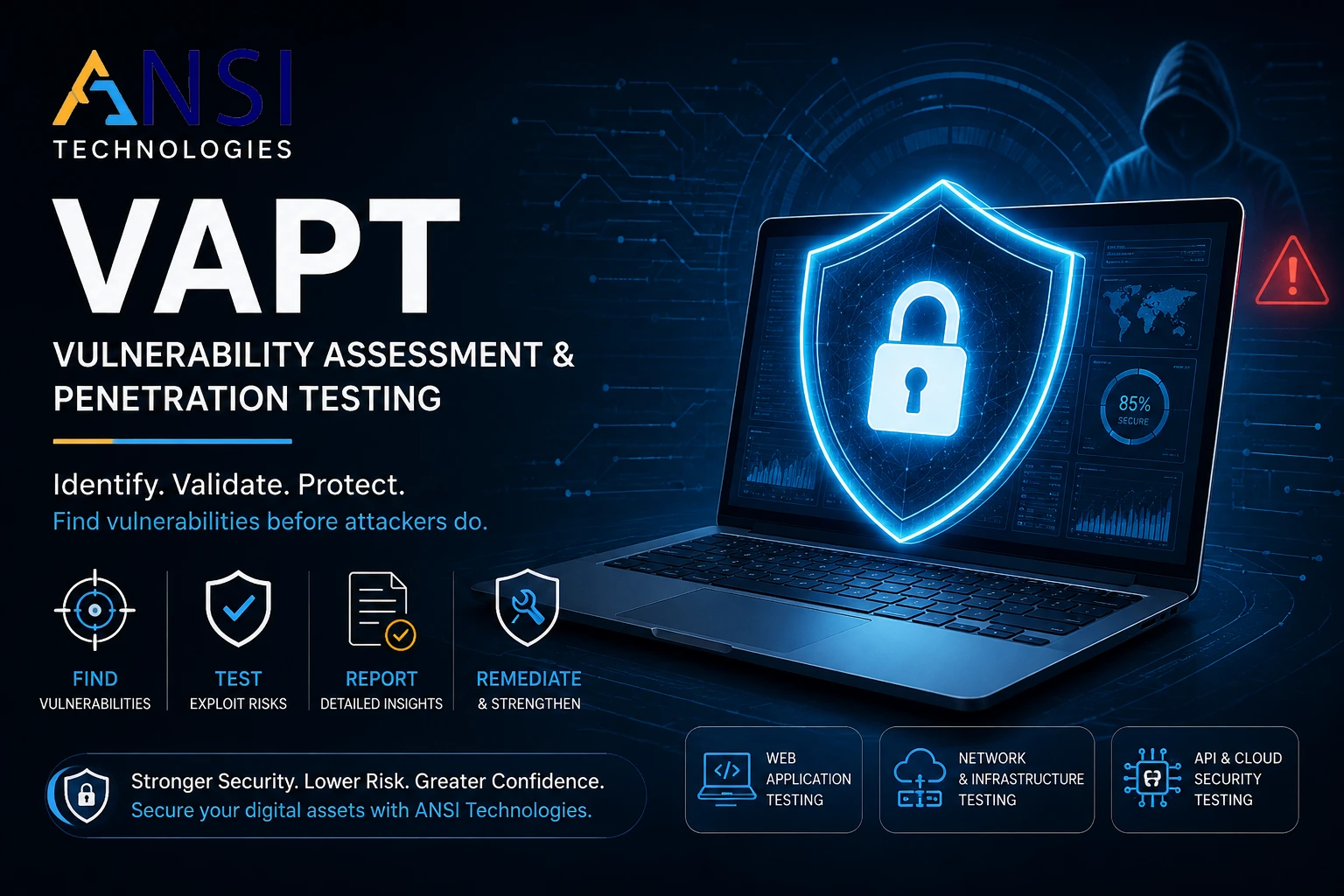
ANSI Technologies provides VAPT and penetration testing services designed to help organizations identify vulnerabilities, understand risk, prioritize remediation and improve their security posture.
What Is VAPT?
VAPT combines two related security activities.
Vulnerability Assessment
A vulnerability assessment focuses on identifying weaknesses across systems, applications, networks, infrastructure and other in-scope assets.
The objective is to answer:
“Where could our environment be vulnerable?”
This can include identifying issues such as:
- Missing security updates
- Weak configurations
- Exposed services
- Insecure protocols
- Authentication weaknesses
- Access-control issues
- Application vulnerabilities
- Configuration errors
- Outdated software
- Cloud security gaps
Penetration Testing
Penetration testing takes the process further.
Rather than simply identifying a potential weakness, authorized security professionals attempt to validate whether vulnerabilities can actually be exploited within the agreed testing boundaries.
The question becomes:
“What could an attacker realistically do with this weakness?”
That distinction is important.
A vulnerability list tells a business where weaknesses exist.
Penetration testing can provide additional context around exploitability, impact and attack paths.
Why VAPT Matters for UAE Businesses
Businesses across the UAE increasingly depend on digital infrastructure.
Websites generate leads.
E-commerce platforms process transactions.
Cloud applications store business information.
APIs connect systems.
Remote access connects employees.
Customer portals provide self-service functionality.
Microsoft 365 and other SaaS platforms support everyday operations.
ERP and CRM systems hold valuable business information.
Each digital connection can introduce another potential attack surface.
The UAE has also established national cybersecurity policies covering areas such as vulnerability disclosure, critical infrastructure, encryption, third-party security and secure data exchange.
The UAE’s National Vulnerability Disclosure Policy specifically establishes expectations around ethical testing and responsible vulnerability reporting.
For businesses, this reinforces an important principle:
Security testing should be authorized, controlled, documented and connected to remediation.
VAPT Isn’t Just About Finding Vulnerabilities
A penetration testing report can contain dozens — or even hundreds — of findings.
But a long report doesn’t necessarily mean a better security outcome.
What matters is knowing:
- Which vulnerabilities matter most?
- Which systems are affected?
- Can the weakness actually be exploited?
- What information could be exposed?
- What business processes could be affected?
- What should be fixed first?
- Which findings require immediate attention?
- Which issues can be addressed as part of normal security improvement?
A strong VAPT engagement should therefore translate technical findings into business decisions.
This is particularly important for management teams that need to understand cyber risk without reading hundreds of pages of technical output.
What Should a UAE Business Test?
There isn’t one universal VAPT scope for every organization.
The right scope depends on the company’s technology environment and risk profile.
However, several areas commonly deserve consideration.
1. Public-Facing Websites
Your website is often one of the first assets exposed to the internet.
Testing can help identify security weaknesses in:
- Login functionality
- Forms
- File uploads
- Authentication
- Session management
- Access controls
- Server configuration
- Application logic
A business website may appear simple to users while containing complex backend functionality.
2. Web Applications
Web applications often handle sensitive business information.
Examples include:
- Customer portals
- Employee portals
- Business dashboards
- Booking platforms
- E-commerce applications
- Internal applications
- SaaS platforms
Application penetration testing can examine how the application handles authentication, authorization, input validation, sessions and sensitive information.
3. APIs
Modern applications increasingly communicate through APIs.
An API may connect:
Website → CRM
Mobile App → Backend
E-commerce → ERP
Payment System → Application
Customer Portal → Database
If API authorization or access controls are incorrectly implemented, an attacker may be able to access information that should remain restricted.
That’s why API penetration testing should be considered when APIs expose business-critical functionality or data.
4. External Network Infrastructure
Internet-facing infrastructure can include:
- Firewalls
- VPN gateways
- Remote-access services
- Public servers
- DNS infrastructure
- Mail-related services
- Cloud endpoints
- Remote administration interfaces
External testing can help organizations understand what their internet-facing environment reveals to an attacker.
5. Internal Network Security
External protection is only one layer.
Businesses should also consider what could happen if an attacker gains an initial foothold.
Internal security testing can help evaluate areas such as:
- Network segmentation
- Privilege escalation
- Internal services
- Authentication
- Access permissions
- Lateral movement opportunities
- Sensitive internal systems
This can be particularly important for organizations with multiple offices, servers, remote users, or complex internal networks.
6. Cloud Environments
Moving systems to the cloud does not eliminate security responsibilities.
Cloud environments can contain:
- Storage
- Virtual machines
- Databases
- APIs
- Identity systems
- Applications
- Administrative interfaces
A cloud security assessment can help identify configuration and access-control weaknesses that could expose business resources.
ANSI Technologies also approaches VAPT as part of a wider security and cloud-readiness strategy, including application exposure, identity, network security and data governance.
7. Authentication and Access Control
One of the most important areas of application security is determining who can access what.
A secure system should distinguish between:
- Regular users
- Managers
- Administrators
- External users
- Service accounts
- Privileged accounts
Testing can examine whether users can access functions or information outside their intended permissions.
This is especially important for systems containing customer, financial, HR or operational data.
A Vulnerability Scan Is Not the Same as a Full Penetration Test
This distinction is important when selecting VAPT services.
An automated vulnerability scanner can identify many known weaknesses efficiently.
But automated scanning alone may not understand:
- Business logic
- Complex authorization relationships
- Application workflows
- Multi-step attack paths
- Context-specific risks
Penetration testing introduces controlled manual validation and security expertise into the assessment.
That doesn’t mean automated scanning is unnecessary.
In many environments, automation and expert validation complement each other.
What Should a Good VAPT Report Contain?
The final report should be useful to both technical teams and management.
A practical VAPT report can include:
Executive Summary
A concise overview of the organization’s security posture and the most important findings.
Scope
Clearly documented systems, applications, domains, IP ranges or environments tested.
Methodology
An explanation of the testing approach and assessment boundaries.
Findings
Individual vulnerabilities with relevant technical details.
Severity
A consistent risk classification.
Evidence
Appropriate evidence demonstrating the finding.
Business Impact
An explanation of why the issue matters.
Remediation
Recommended steps for addressing the vulnerability.
Retesting
Validation that identified issues have been fixed.
ANSI Technologies’ own VAPT guidance emphasizes scope clarity, validated findings, business impact, remediation and retesting rather than treating the assessment as a report-only exercise.
From Finding a Vulnerability to Fixing It
This is where many security assessments lose their value.
A company receives a report.
The security team identifies the findings.
Then the report gets added to a folder.
Nothing changes.
That isn’t the outcome a VAPT engagement should produce.
The more useful lifecycle is:
Discover → Validate → Prioritize → Remediate → Retest → Improve
For example:
Discovery
A vulnerable service is identified.
Validation
The security team confirms the issue and determines its practical impact.
Prioritization
The vulnerability is ranked according to risk and business importance.
Remediation
The relevant technical team fixes the problem.
Retesting
The issue is tested again.
The organization considers why the weakness existed and whether similar problems exist elsewhere.
This creates a continuous improvement cycle rather than a one-time security report.
How Often Should Businesses Perform VAPT?
There isn’t a single frequency that fits every organization.
The appropriate schedule depends on:
- Business risk
- Industry
- Compliance requirements
- Technology changes
- Application releases
- Cloud migrations
- Network changes
- New public-facing systems
- Previous security findings
A business may also need additional testing after significant infrastructure or application changes.
For organizations with frequently changing applications, security testing should be integrated into the development and change-management lifecycle rather than treated as an occasional event.
When Should You Consider VAPT?
A VAPT assessment can be particularly useful when:
You’re launching a new application
Testing before public release can help identify security weaknesses early.
You’re launching an e-commerce platform
Customer and payment-related systems deserve careful security attention.
You’re moving systems to the cloud
Cloud architecture changes can introduce new exposure.
You’re opening remote access
VPNs and remote-access services expand the attack surface.
You’re preparing for an audit
Testing can help identify weaknesses that need remediation.
You’ve experienced a security incident
A post-incident assessment can help identify remaining exposure.
You’ve made major infrastructure changes
New servers, firewalls, applications or integrations can change your risk profile.
Your organization handles sensitive information
Businesses handling customer, employee, financial or other sensitive data should understand where technical weaknesses exist.
VAPT and Compliance: Don’t Confuse Testing With Compliance
VAPT can support security and compliance objectives, but a VAPT report alone does not automatically make an organization compliant with every applicable law, regulation or framework.
Compliance depends on the specific requirements that apply to the organization.
For example, the UAE has distinct national cybersecurity policies addressing areas such as critical infrastructure, third-party security, encryption and data exchange.
Therefore, businesses should first identify their applicable regulatory and contractual obligations and then determine what security testing and evidence are required.
This is much safer than assuming:
“We completed a penetration test, therefore we are compliant.”
Why Businesses Should Think Beyond the VAPT Report
Cybersecurity is not a single assessment.
A company can fix ten vulnerabilities today and introduce a new vulnerability tomorrow through:
- A software update
- A new employee
- A new cloud service
- A new integration
- A new website
- A new API
- A firewall change
- A new third-party vendor
That’s why VAPT should fit into a wider security program.
A mature approach can connect VAPT with:
Identity security
Endpoint protection
Network security
Cloud security
Backup and disaster recovery
Security awareness
Patch management
Incident response
Third-party risk management
Data protection
ANSI Technologies already positions VAPT alongside broader cybersecurity, managed IT, cloud, backup and disaster-recovery capabilities, allowing findings to feed into practical remediation and security improvement.
Why Choose ANSI Technologies for VAPT Services in UAE?
At ANSI Technologies, the objective isn’t simply to identify vulnerabilities.
The goal is to help organizations understand what the vulnerabilities mean and what should happen next.
Our VAPT approach can include:
- Vulnerability assessment
- Penetration testing
- Web application security testing
- API security testing
- External security assessment
- Internal network testing
- Cloud exposure assessment
- Risk classification
- Technical reporting
- Executive-level reporting
- Remediation guidance
- Retesting
The exact scope should be determined according to the organization’s environment and authorized testing requirements.
A Practical VAPT Roadmap for UAE Businesses
If you’re considering a VAPT assessment for your organization, a sensible starting point is:
Step 1 — Identify Critical Assets
List the systems that matter most to the business.
Step 2 — Map External Exposure
Identify websites, APIs, cloud resources, VPNs and other internet-facing services.
Step 3 — Define Scope
Clearly document what is and isn’t included in testing.
Step 4 — Conduct Assessment
Perform vulnerability discovery and appropriate security testing.
Step 5 — Validate Findings
Confirm the practical significance of identified weaknesses.
Step 6 — Prioritize
Focus first on vulnerabilities with the greatest potential business impact.
Step 7 — Remediate
Work with the relevant teams to address the findings.
Step 8 — Retest
Verify that remediation has actually resolved the identified weaknesses.
Step 9 — Improve
Use the results to strengthen security processes and future testing.
Don’t Wait for an Incident to Discover Your Weaknesses
The most valuable vulnerability is often the one you discover before someone else does.
VAPT provides organizations with an opportunity to look at their environment from a security-testing perspective and identify weaknesses that might otherwise remain unnoticed.
For UAE businesses, that can mean greater visibility into application security, network exposure, cloud environments, APIs and access controls.
The objective isn’t to claim that a business can become completely immune to cyberattacks.
No security assessment can make that promise.
The objective is to reduce unknown risk, prioritize weaknesses and make security improvement measurable.
Looking for VAPT Services in UAE?
If your organization needs vulnerability assessment, penetration testing or broader cybersecurity support, ANSI Technologies can help you define an appropriate testing scope and security improvement roadmap.
Explore VAPT Services from ANSI Technologies
VAPT Vulnerability Assessment & Penetration Testing
Our team can help businesses evaluate vulnerabilities across applications, APIs, networks, cloud environments, and other authorized assets.
Find the weakness before an attacker finds it.