

Business growth often creates a technology problem that isn’t obvious at first.
A company starts with a few spreadsheets, email conversations and individual business applications. As the organization grows, sales adds a CRM, finance introduces accounting software, operations maintains its own records, HR manages employee information separately and project teams use another system.
Each application may work perfectly well on its own.
The challenge begins when the business processes between those applications become disconnected.
Sales may not have visibility into finance.
Finance may not know the latest customer status.
Operations may have to request information from sales.
Managers may depend on manually prepared reports.
Employees may enter the same information several times.
For growing businesses in Dallas and across the wider Texas business market, this is where a well-planned Zoho implementation can become valuable.
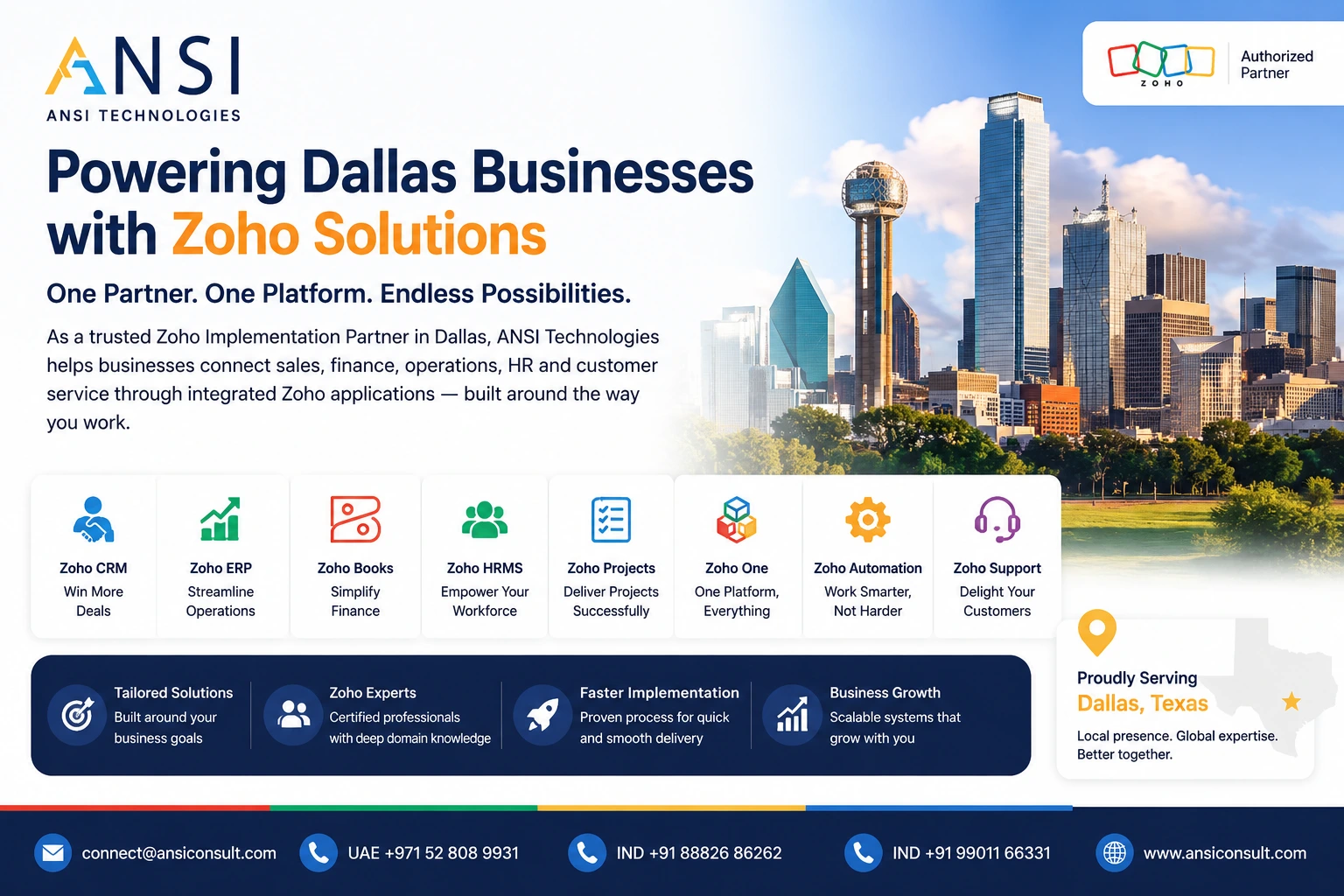
ANSI Technologies helps businesses design and implement connected Zoho environments around their actual processes, including CRM, ERP workflows, finance, HR, projects, automation, customization, integrations and ongoing support.
Why Dallas Businesses Need More Than Basic Software Setup
Dallas is home to a broad business ecosystem spanning technology, professional services, manufacturing, logistics, construction, real estate, distribution and other industries.
That diversity means there isn’t one standard way to implement business software.
A technology company may need:
- CRM automation
- Lead management
- Customer onboarding
- Project delivery
- Support workflows
A distributor may need:
- Inventory visibility
- Purchasing
- Sales orders
- Finance integration
- Customer management
A professional services company may prioritize:
- CRM
- Project management
- Timesheets
- Billing
- Customer support
A growing company may eventually want all of these functions connected.
That is why Zoho implementation should start with business requirements rather than application checklists.
What Does a Zoho Implementation Partner Actually Do?
A Zoho implementation partner should do more than create accounts and configure screens.
A successful project typically involves several stages.
Business Discovery
Understand how the company currently manages sales, finance, operations, HR, projects and customer service.
Solution Architecture
Determine which Zoho applications should be used and how they should communicate.
Configuration
Set up modules, fields, roles, permissions, workflows, layouts and dashboards.
Data Migration
Prepare, clean and migrate relevant business information.
Integration
Connect Zoho with websites, finance systems, payment platforms, communication tools and other required applications.
Automation
Identify repetitive processes that can be automated.
Testing
Validate workflows using realistic business scenarios.
Training
Help employees understand the new processes and responsibilities.
Go-Live
Move the solution into production with an organized rollout.
Optimization
Continue improving workflows, reports, integrations and adoption after launch.
ANSI Technologies’ main implementation offering follows this broader process-first model rather than treating implementation as simple software configuration.
Zoho CRM Implementation for Dallas Businesses
For many organizations, CRM is the starting point.
But CRM implementation should reflect the company’s actual sales process.
A typical process might look like:
Lead → Qualification → Opportunity → Proposal → Negotiation → Closed Deal → Customer
Each organization may define those stages differently.
A Dallas technology company may have a long B2B sales cycle.
A real estate business may require a different lead journey.
A professional services firm may need proposal and project handoff workflows.
A distributor may require sales-order and finance coordination.
ANSI Technologies provides Zoho CRM consulting and implementation, including lead management, pipeline workflows, automation, approvals and revenue visibility.
The goal is not simply to put sales data into CRM.
It is to create a repeatable sales process that teams can actually follow.
Zoho ERP for Operations and Business Management
CRM handles an important part of the customer journey.
But businesses with inventory, purchasing, orders and operational processes often require a wider solution.
This is where Zoho ERP workflows can become important.
For example:
Sales Order → Inventory → Purchasing → Fulfillment → Finance
If each stage is managed independently, employees may need to move information manually.
A connected ERP-oriented approach can provide greater visibility across operational processes.
ANSI Technologies provides Zoho ERP consulting and implementation for businesses that need stronger control over operations, inventory, purchasing and process visibility.
Zoho One for a Connected Business Environment
Some organizations don’t simply need a CRM.
They need several departments to work within one broader ecosystem.
This is where Zoho One can become relevant.
Zoho One can bring together business applications across areas such as:
- Sales
- Finance
- HR
- Projects
- Customer support
- Operations
- Automation
The value isn’t simply having access to many applications.
The value comes from deciding how those applications should work together.
ANSI Technologies provides Zoho One implementation services, focusing on application selection, connected workflows, rollout planning, customization, automation and support.
Zoho Books for Finance and Billing
Finance often becomes a bottleneck when business information is scattered across systems.
Sales may close the deal.
Finance then needs customer information, transaction details and billing requirements.
Without a connected process, teams may repeatedly enter or reconcile data.
Zoho Books can be positioned as part of a wider Zoho ecosystem rather than as an isolated accounting application.
ANSI Technologies provides Zoho Books implementation and consulting, including billing workflows, finance visibility, collections, reporting and CRM-to-finance alignment.
Zoho HRMS for Growing Teams
As businesses grow, HR processes can become increasingly difficult to manage manually.
Employee onboarding, attendance, leave, approvals, payroll workflows and employee records may all involve different people.
A structured HR system can help bring these processes into a more organized environment.
ANSI Technologies provides Zoho HRMS implementation services, covering employee workflows, attendance, leave, approvals, onboarding, payroll-related processes and HR reporting.
Zoho Projects for Client Delivery and Internal Operations
For project-driven organizations, winning the customer is only the beginning.
The business then has to deliver the work.
Teams need visibility into:
- Tasks
- Deadlines
- Milestones
- Responsibilities
- Timesheets
- Project progress
- Customer requirements
ANSI Technologies provides Zoho Projects implementation for project planning, task management, collaboration, timesheets, reporting and delivery workflows.
It can also be connected conceptually and operationally with CRM and finance workflows so the transition from sales → delivery → billing becomes more structured.
Zoho Automation: Turning Repetitive Work Into Workflows
One of the strongest reasons businesses implement Zoho is automation.
Consider a simple lead-management process.
Without automation:
Lead arrives → employee checks email → creates CRM record → assigns salesperson → sends notification → creates follow-up reminder
With a properly designed workflow, several of those actions can happen automatically.
Automation can also support:
- Approval routing
- Lead assignment
- Follow-up reminders
- Notifications
- Invoice reminders
- Support ticket routing
- HR approvals
- Status changes
- Cross-application workflows
ANSI Technologies provides Zoho Automation services covering workflows, approvals, routing, notifications, integrations and dashboards.
The objective isn’t to automate everything.
It’s to automate the activities where automation creates real operational value.
Zoho Customization for Unique Business Requirements
Standard configuration is often the best place to begin.
But every business has differences.
A company may require:
- Custom modules
- Custom fields
- Specialized approval flows
- Custom dashboards
- Customer or vendor portals
- Deluge functions
- API integrations
- Industry-specific workflows
ANSI Technologies provides Zoho Customization services using configuration-first methods, with custom development introduced where it provides genuine business value.
This approach helps prevent unnecessary customization from becoming a long-term maintenance problem.
Zoho Customer Support and Service Management
The customer relationship doesn’t end after the sale.
Customers may need:
- Technical assistance
- Service requests
- Product information
- Issue resolution
- Escalation
- Follow-up
A structured support process can help teams respond consistently and maintain better visibility.
ANSI Technologies provides Zoho Customer Support solutions, including ticketing, routing, SLAs, escalations, knowledge bases, automation and reporting.
For businesses using CRM, connecting customer information with support workflows can create a stronger view of the overall customer relationship.
Why Data Migration Matters During Zoho Implementation
Many businesses don’t start from a clean database.
They may have years of:
- Excel files
- CSV exports
- CRM records
- Customer databases
- Product lists
- Supplier information
- Financial records
Before migrating this information, it should be reviewed.
Duplicate records should be identified.
Old information should be evaluated.
Required fields should be mapped.
Data ownership should be defined.
Otherwise, businesses can move old problems into their new system.
A good implementation therefore treats data quality as part of the project, not as an afterthought.
User Adoption Is Part of Implementation
A technically correct Zoho environment can still fail if employees don’t use it properly.
Users need to understand:
What information should I enter?
When should I update it?
What happens after I submit it?
Who receives the information?
Which reports should I use?
What should I do when something goes wrong?
That’s why training and adoption need to be considered during implementation.
ANSI’s broader Zoho offering includes user enablement, training and ongoing support as part of the implementation lifecycle.
How ANSI Technologies Approaches Zoho Projects in Dallas
A Dallas business considering Zoho should not have to start with a predefined collection of applications.
The better approach is:
1. Understand
Map the current business processes.
2. Prioritize
Identify the workflows causing the most friction.
3. Architect
Determine the appropriate Zoho application mix.
4. Configure
Build the core environment.
5. Integrate
Connect relevant systems.
6. Automate
Reduce repetitive manual work.
7. Test
Validate real business scenarios.
8. Train
Prepare users for the new environment.
9. Launch
Move into production with controlled rollout.
10. Optimize
Improve the system as the business grows.
This is consistent with ANSI Technologies’ current positioning around business-first architecture, connected workflows, phased rollout and post-go-live optimization.
Who Can Benefit From Zoho Implementation in Dallas?
Zoho can support many different business models.
Manufacturing
CRM + ERP workflows + inventory + automation
Professional Services
CRM + Projects + Books + automation
Real Estate
CRM + lead management + automation + reporting
Logistics & Distribution
CRM + inventory + ERP workflows + customer support
Technology Companies
CRM + Zoho One + Projects + automation + support
Construction
CRM + Projects + finance + automation
E-commerce
CRM + Books + inventory + customer support
The right implementation depends on the company’s processes rather than simply its industry.
Choosing a Zoho Implementation Partner in Dallas
Before selecting a partner, businesses should ask several practical questions.
Do they understand business processes?
A good implementation begins with requirements.
Can they integrate applications?
CRM, finance, projects, and support often need to work together.
Can they manage data migration?
Poor data can affect the entire implementation.
Do they understand automation?
Automation should solve a business problem rather than create unnecessary complexity.
Can they customize when necessary?
Some organizations require functionality beyond standard configuration.
Do they provide training?
Employees need to understand the new system.
Is post-go-live support available?
Businesses continue changing after implementation.
ANSI Technologies: Your Zoho Implementation Resource
ANSI Technologies approaches Zoho as a broader business operating environment rather than simply a collection of applications.
The company currently provides a portfolio spanning:
Zoho CRM
Sales and customer management.
Zoho ERP
Operations, inventory and business process workflows.
Zoho One
Connected multi-department business applications.
Zoho HRMS
Employee and HR workflows.
Zoho Books
Finance, billing and collections.
Zoho Projects
Project planning and delivery.
Zoho Implementation
Planning, configuration, migration, training and rollout.
Zoho Customization
Custom modules, workflows, apps and integrations.
Zoho Automation
Approvals, routing, notifications and cross-app workflows.
Zoho Customer Support
Ticketing, SLAs, escalation and service management.
Looking for a Zoho Implementation Partner in Dallas?
If your Dallas business is evaluating Zoho, migrating from another CRM, replacing disconnected spreadsheets, or looking to connect sales, finance, HR, operations, and customer support, a structured implementation can help create a stronger foundation.