


Platform fit
Match ERP choice to finance, inventory, CRM, POS, ecommerce and reporting needs.
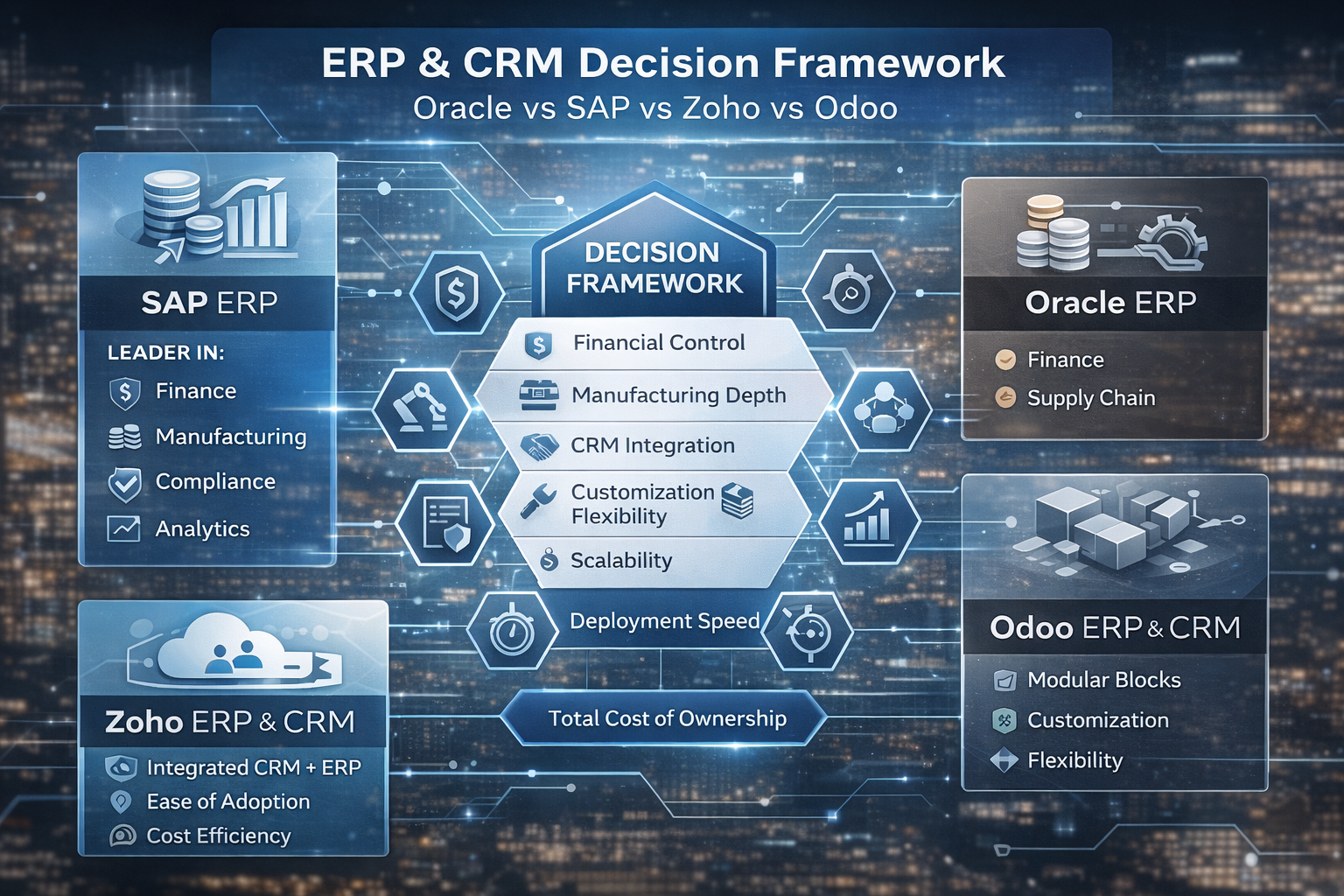
A structured ERP selection guide that helps UAE SMEs compare Zoho, Odoo and SAP Business One based on process fit, cost, operations, finance control and implementation risk.

Match ERP choice to finance, inventory, CRM, POS, ecommerce and reporting needs.
Understand where Zoho, Odoo and SAP Business One projects commonly go wrong.
Compare platforms with a practical scoring lens, not only software demos.
Choosing between Zoho, Odoo and SAP Business One is a major decision for UAE SMEs. Each platform can solve real business problems, but they are built with different strengths. The right choice depends on business size, process complexity, finance discipline, inventory needs, customization expectations, reporting requirements, budget and internal team maturity.
Download the comparison checklist and use it with your leadership team before selecting Zoho, Odoo or SAP Business One.
Many ERP projects fail because the decision starts with software demos instead of business process clarity. A polished demo can hide important questions. How will purchases be approved? How will inventory be valued? How will sales orders connect to invoices? Will ecommerce, POS or warehouses be integrated? Who owns master data? What reports does management need every week? These questions should guide ERP selection.
ANSI Technologies supports Zoho ERP consulting, Odoo implementation, SAP consulting, Zoho One implementation and ERP advisory for businesses in the UAE, GCC and India. This guide is a practical reference for founders, CFOs, operations heads and IT leaders comparing ERP options.
| Area | Zoho | Odoo | SAP Business One |
|---|---|---|---|
| Best fit | Cloud first SMEs that want CRM, finance, HR, projects and automation quickly | SMEs that need flexible ERP workflows, inventory, POS, ecommerce and customization | Mature SMEs needing stronger finance, inventory control, auditability and structured ERP |
| Implementation style | Fast phased rollout across Zoho apps | Process led ERP build with module configuration and customization | Formal ERP project with finance, operations and controls focus |
| Customization | Strong through Zoho Creator, workflows and integrations | Very flexible through modules, custom fields, server actions and development | Available through add ons, SDK and partner extensions |
| Inventory depth | Good for many trading and ecommerce scenarios | Strong for multi warehouse, routes, manufacturing, POS and batch workflows | Strong for structured stock, warehouse, costing and finance integration |
| Finance control | Zoho Books is practical and user friendly | Odoo Accounting is integrated with operations | SAP Business One is strong for finance led control |
| Cost profile | Often attractive for SMB cloud adoption | Flexible depending on hosting, edition, customization and support | Usually higher project governance and support cost |
| User adoption | Friendly interface and quick learning curve | Good when configured cleanly and not over customized | Requires disciplined training and process adoption |
Zoho is often a strong fit for SMEs that want a cloud based operating system across sales, finance, HR, projects, support, marketing and analytics. It works well when the business values speed, affordability, user friendly design and connected applications. For many service businesses, trading companies, consulting firms and growing teams, Zoho can provide a practical route away from spreadsheets without a heavy ERP program.
Zoho becomes especially powerful when Zoho CRM, Zoho Books, Zoho Inventory, Zoho People, Zoho Projects, Zoho Analytics and Zoho Creator are connected around a clear process design. The risk is that companies buy multiple apps without a unified blueprint. That can create duplicate fields, weak reporting and inconsistent workflows. A good Zoho implementation starts with process mapping.
Relevant ANSI Technologies pages include Zoho ERP services, Zoho CRM services, Zoho Books, Zoho HRMS and Zoho One implementation.
Odoo is often a strong fit when a business needs more ERP depth, operational flexibility and module level control. It can support sales, purchase, inventory, accounting, manufacturing, POS, ecommerce, projects, helpdesk, field service and more within one ecosystem. For UAE businesses with warehouse operations, retail channels, batch tracking, POS, ecommerce, procurement and multi step approvals, Odoo can be a strong option.
The main advantage of Odoo is flexibility. The main risk is over customization. If every user request becomes a customization, the system can become difficult to maintain. A good Odoo project should separate standard configuration, necessary customization and future phase improvements. The business should focus on clean workflows, master data governance and reporting from the beginning.
| Odoo strength | Why it matters |
|---|---|
| Inventory and warehouse workflows | Supports practical operational control for trading, distribution, retail and manufacturing |
| POS and ecommerce connection | Useful for businesses with multiple sales channels |
| Customization flexibility | Can match unique workflows when standard configuration is not enough |
| Modular growth | Allows phased rollout across departments |
| Open ecosystem | Supports integrations and extensions when implemented carefully |
Relevant ANSI Technologies pages include Odoo implementation services, Odoo customization services, Odoo maintenance support and Odoo training and adoption.
SAP Business One is usually considered by SMEs that need stronger business control, finance discipline, inventory visibility, approval structure and audit readiness. It is often relevant for distribution, trading, manufacturing and companies that have outgrown basic accounting systems. It can be a good fit where leadership wants a formal ERP backbone and the company is ready for disciplined process adoption.
The strength of SAP Business One is structure. The tradeoff is that it normally requires more formal implementation planning, stronger user training and clear master data ownership. If the business is not ready to standardize processes, SAP Business One can feel heavy. If the business is ready for control, it can provide a strong foundation.
Relevant ANSI Technologies pages include SAP consulting, SAP implementation, SAP support and SAP upgrade and migration.
| Scenario | Likely best shortlist | Reason |
|---|---|---|
| Service business with CRM, projects and billing | Zoho or Odoo | Both can support sales, delivery and billing. Zoho may be faster. Odoo may offer more ERP flexibility. |
| Trading company with inventory and warehouses | Odoo or SAP Business One | Inventory complexity and finance control should drive the decision. |
| Retail with POS and ecommerce | Odoo, possibly Zoho depending on scope | Odoo has strong integrated POS and ecommerce capability. |
| Company with strong finance controls and audit needs | SAP Business One or Odoo | SAP Business One is strong for formal control. Odoo can work if designed carefully. |
| Fast growing SMB needing many cloud apps | Zoho One | Zoho One can unify CRM, finance, HR, projects and automation quickly. |
| Highly unique workflows requiring custom screens | Odoo or Zoho Creator | Both can support custom process design with the right architecture. |
Before choosing a platform, score each option against process fit, reporting fit, cost of ownership, implementation risk, customization need, integration requirement, user adoption, support availability and long term scalability. Do not let software license cost become the only factor. A cheaper system that requires repeated rework can cost more than a structured implementation.
| Criteria | Question to answer |
|---|---|
| Process fit | Can the platform support how sales, purchase, inventory, finance and approvals actually work? |
| Reporting fit | Can leadership get weekly dashboards without spreadsheet reconstruction? |
| Data migration | Is the current data clean enough to move into the ERP? |
| Integration | What must connect to ecommerce, POS, payroll, banking, CRM or third party systems? |
| Customization | Can the requirement be handled by configuration or does it need development? |
| Support | Who will support users after go live and manage improvements? |
| Governance | Who owns master data, approvals, roles and change requests? |
Zoho, Odoo and SAP Business One can all be good choices for UAE SMEs, but each fits a different business maturity level. Zoho is strong for cloud speed and connected apps. Odoo is strong for flexible ERP workflows and operational customization. SAP Business One is strong for finance led control and structured ERP discipline. The best choice is the one that fits your processes, not the one that looks best in a demo.
If you are comparing ERP options, ANSI Technologies can help with process mapping, platform selection, implementation planning and rollout support. Explore Zoho ERP, Odoo implementation and SAP consulting to choose the right path.
Every ERP option has risk. Zoho risk usually comes from treating many applications as separate tools instead of designing one connected process. Odoo risk usually comes from excessive customization, unclear ownership and weak testing of operational workflows. SAP Business One risk usually comes from underestimating the process discipline, training and data preparation needed for a formal ERP environment.
The platform does not create project success by itself. Success comes from clear process owners, clean master data, realistic phases, trained users and a partner that understands business operations. A smaller scope delivered well is usually better than a large scope delivered with confusion.
A controlled demo reveals fit much better than a feature showcase. It also prevents the business from being impressed by screens that are not relevant to daily operations.
ERP cost is not only subscription or license cost. The total cost includes discovery, implementation, data migration, configuration, customization, integrations, user training, support, change requests and internal employee time. A platform with a lower license cost may become expensive if every process needs custom development. A platform with a higher implementation cost may be better if it reduces operational rework and improves control.
SMEs should ask for a three year cost view, not only phase one cost. The three year view should include licenses, hosting if applicable, support, enhancements, integrations and likely future phases. This makes the decision more realistic and helps leadership avoid short term savings that create long term complexity.
The best ERP decision balances functional fit, adoption, implementation risk and future flexibility. When in doubt, run a paid discovery or blueprint before signing a full implementation contract.
Leadership should not ask which ERP is best in isolation. The better question is which ERP best fits the company operating model for the next three to five years. If the business expects more sales channels, more warehouses, more approvals, more entities or more reporting pressure, the selected platform should support that roadmap. If the business needs immediate structure without heavy complexity, the selected platform should support quick adoption.
Before signing, create a short ERP blueprint that confirms scope, integrations, reports, data migration and phases. This blueprint is often the difference between a controlled project and a project that keeps expanding without clear ownership.
There is no single best ERP for every SME. Zoho is strong for fast cloud adoption and connected business apps. Odoo is strong for flexible ERP workflows and customization. SAP Business One is strong for structured finance, inventory and operational control in more mature SMEs.
Zoho can support many ERP style processes when Zoho Books, CRM, Inventory, Projects, People, Analytics and Creator are designed together. It is often a good fit for service, trading and growing SMBs that want cloud speed and affordability.
Odoo is a strong fit when the business needs integrated modules, deeper workflow control, inventory, manufacturing, POS, ecommerce, project operations and custom process design in one ERP environment.
SAP Business One is usually relevant when the business needs stronger finance discipline, inventory controls, approval structure, auditability, multi warehouse management and a more formal ERP foundation.
ANSI Technologies supports advisory, implementation planning, process mapping and delivery support across Zoho, Odoo and SAP related ERP scenarios, helping companies choose based on business fit instead of software marketing.
The biggest mistake is selecting a product before documenting process requirements, reporting needs, data migration, integrations, user roles, approval rules and long term support expectations.
For a wider service view, review Zoho implementation services. ANSI Technologies can connect the guidance in this article with discovery, configuration, data migration, integrations, role-wise training and post go-live support.
ANSI Technologies can review your current environment, confirm gaps and prepare a practical improvement plan for your business.
For location-specific commercial scope and implementation support, use the dedicated ANSI Technologies pages: Zoho ERP implementation in Delhi NCR, Zoho ERP implementation in Mumbai and Zoho ERP implementation in Bengaluru. This article remains focused on education, planning and decision support.
For location-specific Odoo ERP implementation support, see Odoo ERP implementation in Delhi NCR, Odoo ERP implementation in Mumbai and Odoo ERP implementation in Bengaluru. The article itself remains focused on planning, migration, integration or operational guidance.