

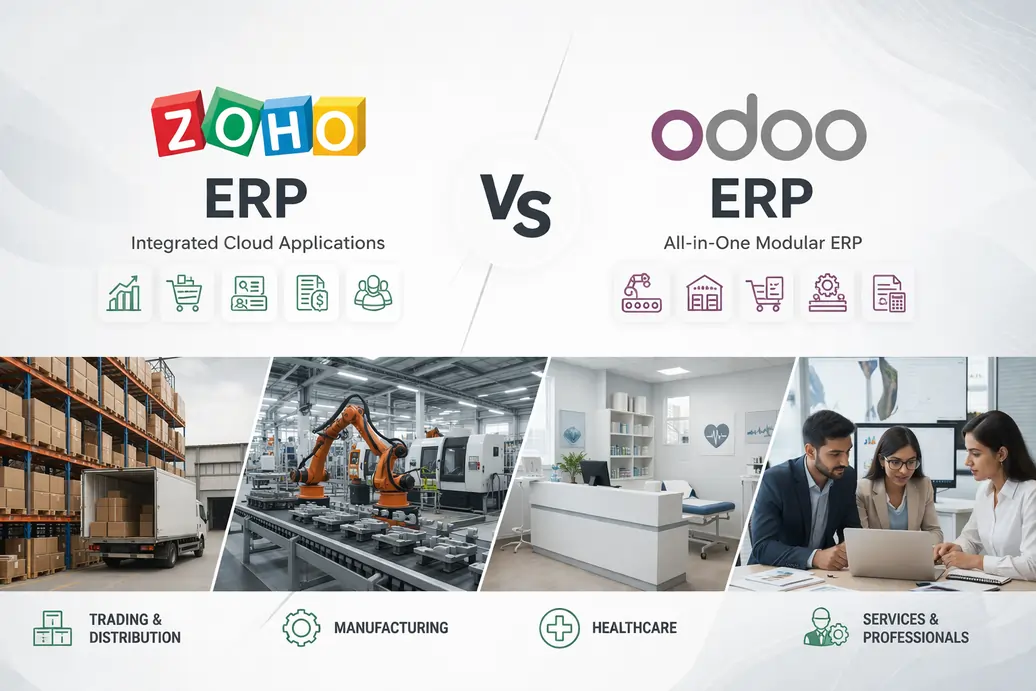
Zoho vs Odoo for UAE SMEs: ERP and CRM Comparison Guide
Zoho vs Odoo for UAE SMEs: ERP and CRM Comparison Guide: compare Zoho and Odoo scope, workflows, migration, integrations, training and support with ANSI Technologies.
Businesses across UAE and India are actively evaluating ERP platforms to streamline operations improve visibility and scale efficiently. Among the most widely compared solutions are Zoho ERP and Odoo ERP.
Both platforms offer strong capabilities but are designed for different types of businesses and operational needs. The right choice depends on industry process complexity customization requirements budget and long term growth strategy.
This guide provides a detailed comparison of Zoho ERP vs Odoo ERP across industries features pricing AI capabilities implementation effort and return on investment.
What is Zoho ERP and Odoo ERP
- Zoho ERP is not a single product but a combination of applications such as Zoho Books Zoho Inventory.
- Zoho CRM Zoho Projects and Zoho People which together form a complete cloud based ERP ecosystem.
- Odoo ERP is a fully integrated modular ERP platform that includes accounting inventory manufacturing CRM ecommerce HR and project management within a single system.
- Zoho ERP is known for ease of use cloud native architecture and business friendly pricing.
- Odoo ERP is known for deep operational control flexibility and strong ERP capabilities.
Zoho ERP vs Odoo ERP by Features
Core ERP Capabilities
Zoho ERP provides finance inventory CRM HR and project management through multiple integrated applications
Odoo ERP provides all modules within one unified platform including manufacturing procurement inventory and accounting
Zoho offers inventory management suitable for small and mid sized businesses
Odoo ERP provides advanced inventory warehouse and supply chain management with deeper operational control
Manufacturing Capabilities
Zoho has limited native manufacturing features and often requires integration
Odoo ERP provides strong manufacturing modules including bill of materials production planning and shop floor control
Accounting and Finance
Zoho Books is highly user friendly and suitable for compliance and financial management
Odoo accounting is powerful and integrated with operations but may require deeper setup
Customization
Zoho allows customization through workflows automation and low code tools
Odoo provides deeper customization through modules and development
Zoho ERP vs Odoo ERP by Industry
Trading and Distribution
Odoo is often a strong fit for trading companies due to inventory procurement and warehouse capabilities
Zoho is suitable where CRM finance and operational visibility are more important than deep logistics complexity
Manufacturing Industry
Odoo is typically the preferred ERP for manufacturing due to strong production planning and operations modules
Zoho can work for light manufacturing or trading linked businesses
Healthcare Industry
Zoho works well for healthcare service providers clinics and diagnostic centers where CRM appointments and billing are key
Odoo can support healthcare operations but requires customization for industry specific workflows
Service Industry
Zoho is highly effective for IT services consulting firms and agencies due to strong integration between CRM projects finance and HR
Odoo can also support services but is more suited when operations and resource planning are complex
Retail and Ecommerce
Odoo provides strong ecommerce and POS integration
Zoho works well for online businesses using integrated apps
Zoho ERP vs Odoo ERP by AI Capabilities
Zoho includes AI features through its ecosystem providing automation insights and predictions
Odoo focuses more on operational efficiency and automation rather than advanced AI
Zoho is currently stronger in accessible AI driven insights while Odoo focuses on process execution
Zoho ERP vs Odoo ERP by Pricing
Zoho ERP is generally more affordable with subscription based pricing
Odoo pricing depends on modules users and customization
Zoho is often more predictable in pricing while Odoo can vary based on implementation scope
Zoho ERP vs Odoo ERP by Implementation Cost
Zoho ERP is faster to implement due to cloud architecture and modular apps
Odoo ERP implementation can be complex depending on customization and modules
Zoho is ideal for quick deployment while Odoo is suitable for deeper transformation projects
Zoho ERP vs Odoo ERP by ROI
Zoho ERP delivers faster ROI due to lower cost and faster adoption
Odoo ERP delivers strong ROI for operations heavy businesses where efficiency gains are significant
ROI depends on proper implementation and business alignment
Zoho ERP vs Odoo ERP Ecosystem
Zoho ecosystem includes CRM Books Inventory Projects HRMS and Zoho One offering a complete business suite
Odoo ecosystem includes accounting inventory manufacturing ecommerce HR and CRM in a single platform
Zoho is stronger for integrated cloud business apps
Odoo is stronger for unified ERP operations
When to Choose Zoho ERP
Choose Zoho ERP if you want
- Affordable cloud ERP
Fast implementation
Integrated business applications
Strong support for service based businesses
When to Choose Odoo ERP
Choose Odoo ERP if you want
- Strong manufacturing and operations capabilities
Deep customization
Unified ERP system
Control over inventory and supply chain
Final Recommendation
Zoho ERP is ideal for businesses looking for a flexible cloud based ERP with strong integration and cost efficiency.
Odoo ERP is ideal for businesses that require deep operational control manufacturing capabilities and advanced ERP functionality.
The right decision depends on business model industry and growth strategy
FAQ's
What is the difference between Zoho ERP and Odoo ERP
Zoho ERP is a suite of integrated applications while Odoo ERP is a single unified platform with multiple modules
Which ERP is better for manufacturing
Odoo ERP is generally better for manufacturing due to strong production and inventory capabilities
Which ERP is better for service companies
Zoho ERP is often better for service companies due to CRM projects and finance integration
Is Zoho ERP cheaper than Odoo
Zoho ERP is generally more cost effective while Odoo cost depends on customization
Which ERP is easier to implement
Zoho ERP is easier and faster to implement compared to Odoo
Which ERP is best for small business
Zoho ERP is often better for small businesses while Odoo is better for operations heavy companies
Can Zoho ERP and Odoo ERP be customized
Yes both platforms support customization but Odoo allows deeper technical customization
Which ERP has better AI capabilities
Zoho ERP offers more accessible AI features while Odoo focuses on operational efficiency
Implementation governance checklist for business teams
A successful Zoho rollout should have clear ownership before configuration starts. The business should identify who owns customer data, product or service masters, approval rules, finance handover, reporting definitions and user adoption. This prevents the system from becoming a collection of screens without operating discipline.
For business teams, ANSI Technologies recommends a practical phased approach: confirm the process, clean the data, configure only the workflows required for go-live, test with real examples, train users by role and review usage after launch. The same governance model can then extend into CRM, finance, inventory, support, HR and analytics as the business grows.
- Confirm process owners for sales, operations, finance and management reporting.
- Prepare clean master data before migration or import activity begins.
- Test real scenarios such as new leads, quotations, approvals, invoices, returns and service requests.
- Train users by role so daily adoption is measured and corrected early.
- Keep a post go-live support plan for workflow refinements, report corrections and new requirements.